


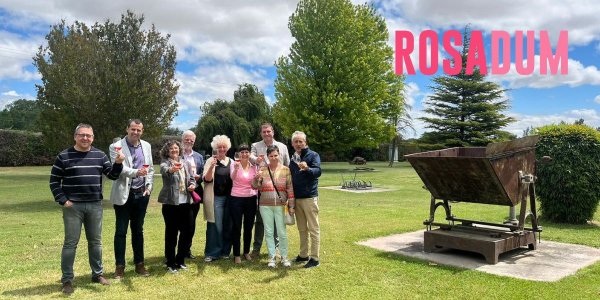
Yesterday, on "World Rosé Day," Rosadum was celebrated in Navarra, a technical conference on rosé wine that was attended by top-tier international experts. The event discussed the rise of this category, as well as its evolution, challenges, and opportunities.
Navarra, a wine region world-renowned for its rosé wines, hosted yesterday at the headquarters of EVENA (Navarre Viticulture and Enology Station), an event designed to analyze the global situation of rosé wine.
The event organized by the Department of Rural Development and Environment of the Government of Navarre, with EVENA, and in collaboration with the Navarra Designation of Origin Regulatory Council and Reyno Gourmet, brought together professionals for an essential meeting for the sector.
The general director of Rural Development and Environment of the Government of Navarra, Rubén Goñi and the president of the Regulatory Council of the D.O. Navarra, David Palacios were in charge of the opening, claiming the role that rosé wine has played in the history of Navarra and the pride of hosting a technical event that promotes knowledge of this magnitude. Nathalie Pouzalgues, head of projects at the Center for Research and Experimentation of Rosé Wine in Provence, spoke about the panorama of rosé wines in the world, their current situation and future forecasts, emphasizing her experience with rosés from her production area. After Pouzalgues, Alfredo Rueda Díez, Head of the Oenology Department of the Department of Rural Development and the Environment, and Teresa Garde, researcher of the VIENAP Group of the Institute of Vine and Wine Sciences, took the floor to present the results of a comparative trial of rosé production in which they concluded the great qualities present in the wines produced by the bleeding method compared to the pressing method.
Later, Rafael del Rey, director of the Spanish Wine Market Observatory (OEMV) shared with the attendees the commercial reality of the rosé wine market nationally and internationally, confirming the real growth of sales of this category beyond fashions. The next intervention was made by Elizabeth Gabay, Master Of Wine and recognized for being one of the most important writers and consultants on rosé wines in the world, exposing the history and evolution of this wine and delving into the experience, successes and mistakes of the main producing areas. Félix Cibriáin Sabalza, Head of the Viticulture Department of the Department of Rural Development and Environment of the Government of Navarra, and Pilar García-Granero, oenologist and professor at the Basque Culinary Center, were in charge of closing the presentations by delving into the history and evolution of rosé wine in Navarra. In their presentation, they demonstrated the ancestral tradition of Navarre in the production of rosé, dated in the year 1406 in the Royal and General Archive of Navarre under the denomination of red wine.
So, Rosadum laimed to establish itself as an extraordinary day of specialization and reflection, setting an unmissable event for professionals on the calendar and consolidating Navarra as a historic and innovative wine region in the production, culture, and leadership of rosé wine.
"Rosé wine has put Navarra on the global wine map, and we are leaders in the domestic market. But we can't stop there. As leaders, we have to grow in value, and now is a great time because rosé consumption is a trend, and we must seize that opportunity."declared David Palacios, president of the Regulatory Council of the Navarra Designation of Origin.
In parallel, Nathalie Pouzalgues and Elizabeth Gabay they expressed the great quality they had found in the Rosé wines from the Navarra Designation of Originin a cat held the previous day at the Regulatory Council. The experts highlighted the freshness, quality, innovation in aging, and the distinct personality of the wines, transmitted by the different terroirs of the five production zones of the D.O. Navarra.
 English
  Spanish
  German