


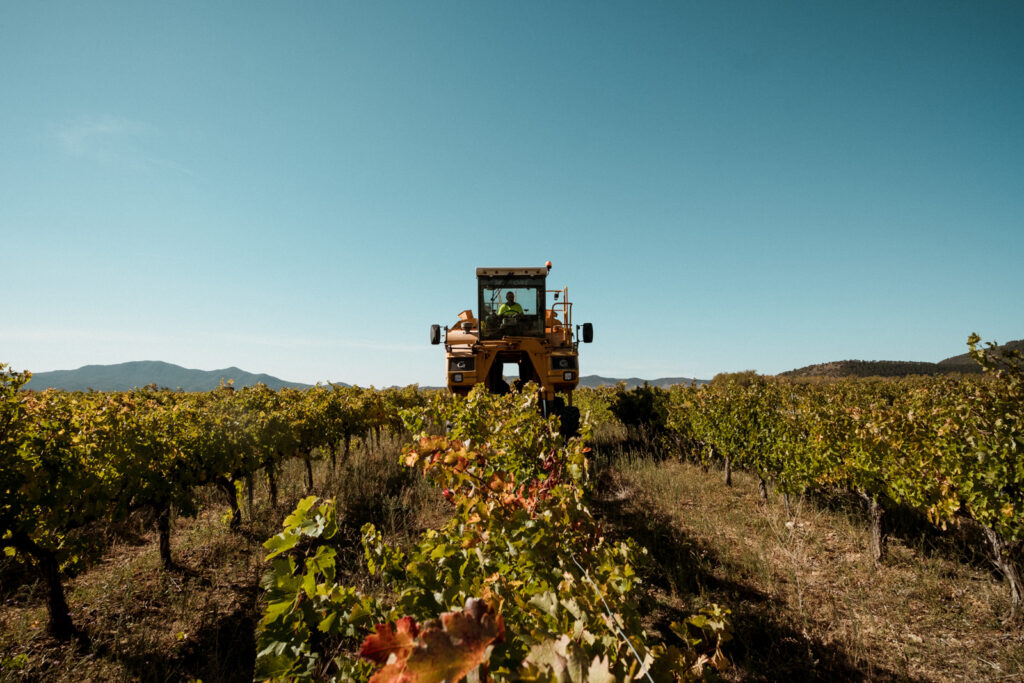
The high temperatures recorded this summer in Navarre have accelerated the grapevine cycle and brought forward the start of the harvest, which is expected to be of good quality and with a higher production than in recent campaigns.
The grape harvest in the Navarra Designation of Origin has already begun. This weekend saw the start of the first harvests of white grape varieties in towns in the Ribera Alta and Ribera Baja regions, marking the beginning of a season that is starting much earlier than in previous years. Initial production forecasts, prepared by the Government of Navarra’s Viticulture and Oenology Section (EVENA), point to a harvest of 39,367,879 kilograms of grapes, representing an estimated increase of 14% compared to the 2025 harvest.
This year, the grapevine's vegetative cycle shows a very significant advancement both with respect to the previous season and the historical average. The productive potential is at average levels for the main varieties, conditioned by the drought recorded during the months of June and July and by the high temperatures of recent weeks. Despite these circumstances, the constant monitoring of the vineyards and the work carried out in the field have made it possible to maintain an optimal health status of the grape, which allows facing the harvest with good quality prospects.
Although in spring the fruit we expected was abundant, the continuous and unusual maximum temperatures for Navarre that we have experienced in recent months will cause production forecasts to be more moderate than initially expected. Even so, it will be a higher harvest than those of recent campaigns, which were marked by historical lows. From the D.O. Navarra we face this moment with enthusiasm and with the confidence that, once again, we will produce excellent wines, states David Palacios, president of the Regulatory Council of the D.O. Navarra.
In the 2026 campaign, 81 wineries and more than 1,350 viticulture professionals will participate, harvesting grapes from more than 8,375 hectares of vineyards spread throughout the territory of the Navarra Designation of Origin.
Unlike previous campaigns, this year there has been no possibility of opting for green harvesting as a measure to regulate production. However, the Regulatory Board maintains, as in previous campaigns, yield limits per hectare of 7,500 kg/ha for red varieties and 9,200 kg/ha for white varieties, prioritizing the quality of the grapes and wines over production volume.
The climatic diversity of the five wine-growing zones that make up the D.O. Navarra—Ribera Alta, Ribera Baja, Baja Montaña, Valdizarbe, and Tierra Estella—means that the grape harvest will progress gradually and last for approximately two months.
Among the white varieties protected by the Navarra Denomination of Origin are Chardonnay, Garnacha Blanca, Moscatel de Grano Menudo, Viura, Malvasía, Sauvignon Blanc, and Oneca, while among the reds, Garnacha Tinta, Tempranillo, Graciano, Mazuelo, Cabernet Sauvignon, Merlot, Syrah, Pinot Noir, and Garnacha Gris stand out. All of them will be the protagonists of D.O. Navarra wines—whites, rosés, and reds—recognized for their freshness, diversity, and character, and reflecting a territory with a long winemaking tradition located in the north of the Iberian Peninsula, home to some of the northernmost vineyards in Spain.
New releases: Village Wines and Traditional Rosé
The 2026 campaign also introduces a major new development for the Navarra Designation of Origin: this will be the first harvest in which the production of the new "Vinos de Pueblo" (Village Wines) and "Rosado Tradición" (Traditional Rosé) can begin, two designations approved by the Plenary of the Regulatory Council and incorporated into the specifications of the Designation of Origin.
The "Vino de Pueblo" (Village Wine) will make it possible to highlight the specific origin of the grapes and recognize the municipality they come from on the label. These wines will also be subject to more demanding production conditions and more limited vineyard yields, with the aim of enhancing the expression of the terroir and favoring higher quality and higher value-added productions.
On the other hand, "Rosado Tradición" was created with the aim of protecting and highlighting one of the most traditional and characteristic winemaking methods of the D.O. Navarra. It is a rosé made exclusively from Red Garnacha using the traditional saignée (bleeding) method, which must present a color intensity between 0.35 and 1.65 absorbance units per centimeter (Abs. Un./cm). With this new designation, the D.O. Navarra revives and champions one of the historical identities of its rosé wines.
 English
  Spanish
  German